To be clear: This is not my position! I advocate for service accounts in my post:
> It is much harder to reason about, say, the security of an arbitrary Engineer's laptop than it is an EC2 instance that exists exclusively to tell KMS to sign something.
> So every time we fire or lay off the person whose name is on the automation, we need to rotate the keys?
If a person previously had access to the key and knowledge of the key gives you control over that automated workflow, is that key (and by extension that workflow) still worth trusting?
Part of the threat model for an Engineering team is that people come and go. They move teams which have different levels of access. They leave the organization, in most cases, on good terms. I want to set up infrastructure where I don't need to remember that your SSH pubkey is baked into production configuration after you leave the company.
There are several options for setting up per-connection keys that are dispensed to users through the company SSO. That setup means you don't need to maintain separate infrastructure for (de-)provisioning SSH keys.
This is completely solved by SSH certificates. You still have the same private key in the hardware, but instead of using the public key directly, you issue temporary (~1 hour) SSH key certificates. I even automated it using an SSH proxy.
The target machines then just need to put the CA cert in the authorized_keys files.
> "Had the engineer that acted on that known better, or did other checks, this would have been avoided."
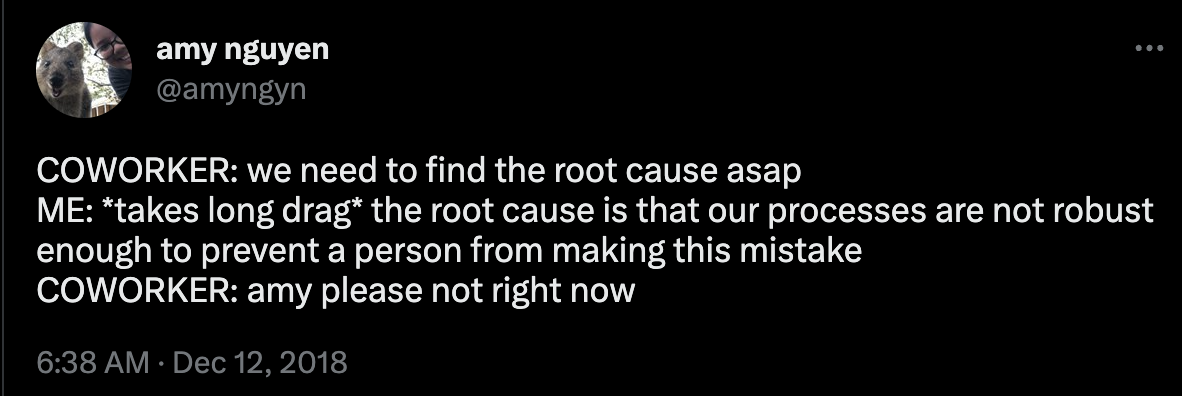
<insert takes long drag tweet[1] here>
I personally find "LLMs can do $THING poorly" and "LLMs can do $THING well" articles kinda boring at this point. But! I'm hopeful that stories like this will shift the industry's focus towards robustness instead of just short-term efficiency. I suspect many decision making and change management processes accidentally benefited from just being a bit slow.
> The job of a code reviewer isn't to review code. It's to figure out how to obsolete their code review comment, that whole class of comment, in all future cases, until you don't need their reviews at all anymore.
Making entire classes of issues effectively impossible is definitely the ideal outcome. But, this feels much more complicated when you consider that trust doesn't always extend beyond the company's wall and you cannot always ignore that fact because the negative outcomes can be external to the company.
What if I, a trusted engineer, run `npm update` at the wrong time and malware makes its way into production and user data is stolen? A mistake to learn from, for sure, but a post-mortem is too late for those users.
I'm certainly not advocating for relying on human checks everywhere, but reasoning about where you crank the trust knob can get very complicated or costly. Occasionally a trustworthy human reviewer can be part of a very reasonable control.
Japanese manufacturing addressed this too! There’s a whole branch of Deming’s work around supply chains and how it’s often worth working with “more expensive” suppliers when their quality is consistently high, because compensating for low quality inputs to your own work is far more expensive.
It’s also the case that someone you trust makes an honest mistake and, for example, gets their laptop stolen and their credentials compromised. I do trust my team, and want that to be the foundation to our relationship, but I also recognize that humans are infallible and having guardrails (eg code review) is beneficial.
Congratulations! Fish is such a wonderful shell. It’s been my daily driver for many years now but I’ve had a renewed appreciation for it now that I’m working in several different development environments.
The default fish install Just Works so well that I don’t bother with trying to schlep my dotfiles around.
While there are compliance/security benefits it is not the primary motivation.
If you have fairly complicated infrastructure it can be way more efficient to have a pool of ready to go beefy EC2 instances on a recent commit of your multi-GB git repo instead of having to run everything on a laptop.


To be clear: This is not my position! I advocate for service accounts in my post:
> It is much harder to reason about, say, the security of an arbitrary Engineer's laptop than it is an EC2 instance that exists exclusively to tell KMS to sign something.
> So every time we fire or lay off the person whose name is on the automation, we need to rotate the keys?
If a person previously had access to the key and knowledge of the key gives you control over that automated workflow, is that key (and by extension that workflow) still worth trusting?
reply