Sure, I was more speaking to usage... I'd have to imagine that querySelector* dwarfs evaluate in actual usage. Chrome's stats put evaluate at about 5% of loads; I'm not sure they have tracking for querySelector.
Of course XPath has its place and is the better tool for some situations. On the PHP side XPath has been supported for a long time, while the querySelector stuff is quite new.
You simply can't get hung up on what could have been. Same applies to trying to time the stock market... should have bought, should have sold. Best thing is to know there's nothing that can be done about the past and move along and deal with what you can do now instead.
You're right. What gets me though is that unlike the stock market, bitcoin was an incredibly rare occurrence where anyone could have gotten extraordinarily rich without even incurring any risk! (besides a couple evenings spent learning how to use it.) Whereas to have $10MM today in GOOG stock, I would have had to invest over $300k in 2010.
That's not true at all, any number of things could have killed bitcoin in its infancy. The stakes were just low. Somewhere out there is a lost collection of wallets of mine, collectively holding ~100btc ($1000 at the time). If regulators cracked down hard, that 100btc would have become just as worthless and either way I'd be out $1000.
"Risk" is an epistemic claim about the future taking the worse path. Obviously looking back it looks like risk-free money. That's not how it looked at the time. The "currency of the future" thing was always niche, especially after the crash in 2013, until a much larger cultural shift happened around 2015-ish.
Plenty of people will chime in with early bitcoin stories, and how they always believed it was going to go to the moon, etc. I always find it curious because my memory of the time period is that it was a means to an end, and that's how the overwhelming majority saw it and treated it. Funnily enough, it was thanks to that overwhelming majority that led to it being worth anything at all. If it was just a bunch of yahoos clamoring about the "currency of the future" thing, it probably would have gone absolutely fucking nowhere. The irony that the yahoos ended up becoming the majority I think is underappreciated.
You could have bought bored apes (and any of the other scammy NFTs) and ended up losing your shirt in the end. Overall, who cares if you miss the boat on something, it's not good for the mind to dwell on it.
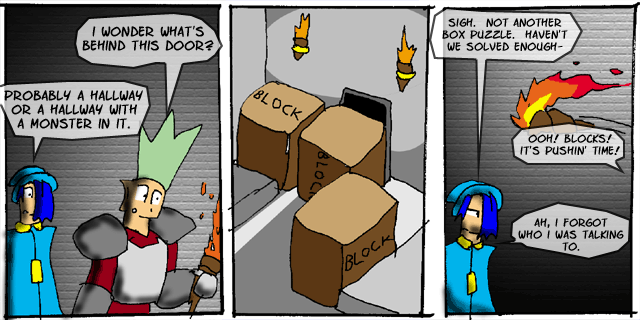
Almost anybody who grew up with video games in the 80s played Sokoban and knows exactly what that refers to. It was THE puzzle game in the early days of video games... that and maybe millipede.
Puzzles involving pushing blocks around a grid, where most of the challenge comes from the constrained motion. Blocks might get stuck if you push them into a corner, for example. It might be necessary to move things in a certain order, which isn't obvious at first.
"Sokoban" translates to "warehouse keeper". The original game was about moving boxes around in a crowded warehouse.
Being familiar with the concept isn't the same as being familiar with the term. The point that was being made by the parent comment that originally mentioned the term was that the game does not do a good job describing what it actually is to people who aren't already familiar with it. People who have never played a game in their life will know what the words "real", "time", and "strategy" mean, so I don't know how you can claim that it's anywhere close to the same thing.
Knowing what the word "strategy" means doesn't tell you anything about what a "real-time strategy game" is.
Even knowing what a "strategy game" is won't help, since the meaning of that term has shifted since "RTS" was derived from it.
Similarly, knowing that Sokoban means "warehouse guard" doesn't help you to know what to expect in a Sokoban game. But the fact that this is a common term familiar to ~everyone does.
When everyone around you is using a word with no problems, don't complain that you wish they'd all forget what it meant. Learn how to talk.
> When everyone around you is using a word with no problems, don't complain that you wish they'd all forget what it meant. Learn how to talk.
Literally this whole discussion started because someone else didn't know what it meant. No one said you should forget what it means, just that it's helpful to explain to other people so that they also will understand it in the future. Most people learn by asking questions and getting answers that explain things to them. The best way to get people not to learn is to incentivize them not to ask questions, which is exactly what you're doing by saying things like this.
> Literally this whole discussion started because someone else didn't know what it meant. No one said you should forget what it means
If you scroll up, you'll see that the discussion started when someone suggested that either the publisher, or the reviewer, should avoid "niche words like sokoban".
If we think they were talking about the review, that's pure nonsense; this is a review on "thinkygames.com".
If we think they were talking about the publisher, they're correct in spirit, but the advice to avoid not-actually-niche words like "Sokoban" is dead wrong. The publisher's page is intentionally uninformative. The description contains no information and the gameplay video contains no gameplay. I'd have to agree that that's an artistic choice that won't help to sell the game.
On the other hand, the user-defined tags on Steam aren't subject to that artistic choice, and they tell you right up front that this is a Sokoban game. That's how the game's player base describes the game. It's the only way they describe the game - the other popular tags are "puzzle", "indie", "difficult", singleplayer", and "cooking".
The advice "try not to let the people who'd be interested in your game know what it's about" is terrible advice.
(Tangent: I checked the user-defined tags for some other big games on Steam. Mostly they're extremely accurate. In one case, Vampire Survivors, the tags aren't very informative. But in that case, the video prominently displays a review quote that says "like popping bubble wrap to sick beats", which is an excellent description of the game.)
I'm in Canada and have been a Deezer subscriber for almost 2 decades now. Their premium subscription is well worth the money - I pay less than $90 for the year. They also have one of the highest track counts available compared to other streaming services (according to google).
And sometimes the maintainer simply doesn't respond to a perfectly acceptable issue due to either the maintainer abandoning the project, not enough maintainers or simple neglect.
I'm a native English speaker who's very exposed to French, but doesn't speak it, I find the use of accents in French very welcome to getting the pronunciation right when exposed to a new word. English is just a mess in comparison and I wish it had made use of accents as well to avoid a lot of the ambiguities in pronunciation. Perhaps some of the old English letters that are no longer in use helped a bit, but I'm not familiar enough with those to know if it used to be better.
You mean kinda like how (as I recently was informed) "ye olde" is actually pronounced "the old" but written "ye" because of printing issues, and consequently mispronounced by almost everyone?


https://developer.mozilla.org/en-US/docs/Web/API/Document/ev...
reply