For an more in-depth look at some of the capacity benefits of HS2, this article on the London end of HS2 by ianvisits.co.uk is definitely worth a read:
> Building not just more platforms for HS2, but critically, the extra tunnels for those trains to use shifts intercity services to the HS2 line, releasing lots of capacity in the old tunnels for suburban services. If that doesn’t sound too important, then where’s the UK’s most congested train... it’s the 17:46 out of Euston which carries more than twice the number of passengers that it’s designed for. When completed, HS2 is expected to more than double the number of seats out of Euston station during peak hours.
It seems building HS2 is only part of the cost. A lot of it is also paying down "infrastructure debt" that hasn't been touched for decades.
At the risk of sounding like a contrarian, I think HS2 should go ahead now. I was against it years ago, but times have changed since the idea was floated.
The amount of track has gone down as rail travel has gone up. Passenger numbers are even higher than predicted when HS2 was proposed. We are at capacity.
Double decker trains like abroad are too wide for the tracks. Longer trains would also require major works at stations.
I don't think saving 20 minutes off the journey matters either, but I also don't think that is the main benefit of the project.
I don't really get why it's such a high priority to expand the London commuter belt. Train lines may be at capacity but if more money was devolved into the northern regions so everyone doesn't have to commute to London maybe we could solve the problem in a cleaner and less costly way.
But then the contractors won't get their back pockets filled.
I thought that as internet speed and quality increased, we would see more office work being dispersed across the country. More people would be able to work remotely or in small satellite offices using the internet to effectively coordinate. The role of the (London) headquarters of larger companies would be diminished.
Instead it feels to me like companies have become more centralised. Regional offices are gutted (much of their work can be done over the internet from headquarters), more firms are crammed into London, all competing for the same people and this competition drives up wages (and house prices) and this encourages more people to want to work there which makes it one of the few places for companies to find talent and so on.
Maybe my impression of the state and change of things is just wrong. But my theory of the change in office work due to the internet is that it let things become more centralised and that this change is the reason for various other political changes (eg rising house prices -> weird policies to help people buy houses without decreasing the sale price; pushes towards better transport infrastructure in and to London; weakening of the rural and regional economy; trains in high demand which everyone hates; ...)
Yes. The work of Ronald Coase on why businesses exist at all is more relevant than ever. Coase asked the question: "why is there such a thing as a business and why are they the size they are? Why isn't everyone an independent contractor? Conversely, why isn't the whole economy one big conglomerate".
His answer is essentially transaction cost and co-ordination overhead. So logically as technology changes those, the natural size and configuration of businesses and other organisations changes.
What has ended up happening is that modern communications has made it much easier to do business to business transactions over larger distances than before, which has led to centralising to a smaller number of specialist firms rather than a larger number of geographically spread firms. This has been very noticeable in areas like law as well. There was a time when a manufacturing business in the Midlands had a local accountant, local law firm, etc. Now that is all centralised in a small number of cities. This has led to a more hub-centric global economy than ever before.
Now you might expect that this same effect would also encourage more remote working which would have the opposite effect on firm concentration geographically. It seems to have turned out that the effect of the same technology within firms has been less drastic. In other words, while it has led to more remote working and more part time working from home, it has not had the drastic effect of completely blowing up the nature of the team.
I suspect this has something to do with human nature and with transaction cost. Basically making a b2b relationship more geographically distant has turned out to be easier than physically dispersing a team within the low transaction cost company boundary.
Google does search for everyone... but Google employees are usually expected to spend at least a few days a week physically co-located with their teams.
All the world's widebody aircraft engines are made by only two manufacturers... who choose to concentrate their own design operations geographically.
As a result, paradoxically it seems that modern technology has led to more geographical concentration rather than less.
If we want to counteract that in the UK, we need to create counterweights to London. To a certain extent that already exists for things like aerospace and high end automotive - if you were starting a new business there you'd be crazy not to do around Derby. The challenge is that in most other areas London is so dominant that its dominance becomes a self fulfilling prophecy. No idea how to do that though.
The effect of transport links on all this is quite hard to predict as well. Do you end up making well connected cities and towns economic extensions of London in terms of creating employment there? (Might as well start a tech company in Birmingham if it's so close to London). Or do you just turn them into commuter communities?
So this leads to the question of why firms don't like remote work (on average) and whether that might change.
My guess is it's a combination of:
• Corporate videoconf systems being unbelievably atrocious and unreliable compared to consumer tech.
• Ditto for standard communication tools like Outlook.
• The current generation of non-tech CEOs mostly being older people who either don't actually use electronic comms much, or don't like using it. E.g. my CEO doesn't use Slack at all, even though everyone else does, and most of his email is handled by his assistant. When he does write emails they're usually just one or two lines long.
• Remote work places far greater weight on reading and writing ability, areas where many people are surprisingly weak but reluctant to admit it. Physical meetings are much easier on people, both in terms of requiring less mental effort and allowing people to just zone out rather than work.
The latter two have no obvious fixes. On the other hand, corporate videoconf infrastructure that doesn't suck seems like it should be easier to fix. The perennial problem of "I'm five minutes late because {the dialin was missing, didn't work, my microphone was muted, etc}" is entirely solvable with better software. Unfortunately the industry's best people all focus on consumer workloads where scaling to massive success is comparatively easy and sales-free.
I think we first have to answer a more fundamental question: Are there advantages to physical co-location that cannot be replicated using better computer collaboration tools? If so, then it may be that improving tools will never get us there. This is especially true for genuinely remote working, I think the tools to allow part of the team to work from home part of the time are there and in many industries are ubiquitous.
Bobthepanda is right, watercoolers win, and it's pretty clear that compressing 20 locations into 3 can always be made to look like a flying business case on a spreadsheet and a ppt deck - especially when you make arbitary claims about efficiency gains. I was party to a case where consultants (biggest and most expensive ones) introduced a 7% co-location bonus with no evidence or justification at all and this promptly yeilded a £100m investment in the realestate to support it. No one really argued because the alternative was 0 investment, and the axe man commeth for those who were on the periphery in any case.
Actually, I lie. I argued, but now I work in a different place... coincidence?
My point would be I think that there are pros and cons, distributed offices have huge pathologies, but centralised facilities often just don't work, and those failures are simply ignored or covered up in the modern workplace. I do not believe that the facts of what happens in these reorganizations could be measured if the faculty of Harvard and the LSE were to be onsite interviewing executives 24-7 in a corporate going through this. The beast must be fed, and those who get thrown in the maw don't count.
Upvoted for Coase; far more people on HN should read his work, because those questions you mention are extremely critical to explaining a lot of things. All the "gig economy" firms are practical Coasianism.
You might be interested by the idea of "Coasian Hells" which are situations where someone has tried to set up a delivery structure that doesn't match transaction costs. Good examples:
-UK rail (in practice train operators, the railway operator, and rolling stock leasing companies spend vast resources trying to charge each other for things)
-Boeing's supply chain for the 787
Basically every failed outsourcing project has failed because the people designing it did not understand the implications of Coase
Because you are at capacity now. Don't get me wrong, I'd love to see a smaller divide between N and S, but if you start investing heavily in the N now before it actually has a meaningful impact on people's internal economic migration/commuting patterns it's going to be at least a decade (convince companies to move there, start hiring, create a salary inflation cycle from competition, etc...)
Right now, London salaries are easily 2x to 3x Manchester's for Software devs (yeah I know the average data is only 30% higher but you need to compare the top vs the top, not the aggregated data). As a Junior dev moving from Hertfordshire (which is 30mins from London....) to London meant my salary instantly doubled, while living cost only maybe increased 50% if we are conservative. That's going to take a long time to offset.
>>"But then the contractors won't get their back pockets filled. "
Are you saying that if money was spent on Northern infrastructure instead, it somehow wouldn't go to the same contractors? Contractors are agnostic on where the infra spend is geographically.
No I'm just saying that HS2 seems to be more of a contractor back-pocket filler than other more meaningful projects. The amount that has gone in to build a slightly faster trainline is obscene (plus it's not actually going to be faster for most people since it's probably going to stop outside London).
I still don't understand. Is it that you think HS2 has higher margins for contractors than other projects? Otherwise spending an equivalent amount on large infrastructure elsewhere in the country would end up benefitting exactly the same contractors.
> There are at least 100 stations across the north and Midlands that would benefit from released capacity, according to Network Rail, which owns and manages Britain’s railways.
There are signs that the second, northern stage of HS2 - which is the one that might benefit the north - might never happen. It's been pushed out way into the future and our politicians are talking about reviewing it. The only part that's definitely going ahead is the first phase which serves London.
It's not just the northern regions that lose out. HS2 improves rail travel into and out of London at the expense of diverting funds and resources away from improving rail travel within the commuter belt and allowing it to function as something other than housing for London workers that can't afford to live there.
This is a fairly good article explaining the benefits of HS2 - it sounds like politicians have simply failed to get across what exactly HS2 is intended to accomplish and how it will benefit the country beyond LDN.
Certainly, I'd not much thought of it in these terms.
From what I understand the reason why the price tag is so high is that _all_ the contractors are liable for _everything_ up to 20 years after construction.
“Now contractors do not carry the risk. That should help keep prices down.” Perhaps, but the costs will remain the same because someone (the public) is still going to have to insure that risk. Worse still, the accounting for risk is being removed from those who are best placed to do it.
This is nothing more than a desperate bid to reduce the sticker “price”, fooling precisely nobody.
Just as an aside, it's worth noting that there's case law in the UK suggesting that if you aren't insured you aren't a proper specialist. The insurance companies don't do nominal insurance for this purpose, so the costs are there either way. I may have a flawed understanding of this but it seems like an oddity in how we consider what constitutes professional or specialist tradesperson that would inevitably inflate costs.
There is very little competition in those contracts. There one or two main contractors and that's it.
Basically, if Balfour Beatty says we need £x, then they'll get £x because the market is locked with the blessing of the government.
This sort of article always tries to rationalise the price tag but rarely goes into investigating beyond that, including the issue of the glacial pace of most projects.
Moving risk to the party with the lower cost of capital (contractors have a very high cost of capital) is a real saving. Obviously, yes, the risk itself still exists and will now be borne by the public.
They'd probably need to be combined with a map of population density and nature reserves to produce a "rail planners map". You can already see where the "empty" areas of the UK are already, like the Scottish borders.
If you stood by the track, a train could pass you at 360km/h (224mph) every 3 1/2 minutes - the kind of safety and control systems to make that possible must be astounding.
HS2 will, unlike the rest of the UK legacy network, use ETCS: https://en.wikipedia.org/wiki/European_Train_Control_System (at level 2 with the possibility of level 3). Conceptually it's the same as the ancient tokening system - a train requires a token to enter a particular section of rail. Except these are digital tokens granted over a cryptographic protocol over the GSM network or trackside radios. When a train has cleared a particular point, a calculation is made based on the speed and braking distance of the train behind, which is then granted an authority to move further along the track. As long as the train receives a continuous series of valid "movement authority" tokens for the correct sections, it will proceed. If not, it applies the brakes.
> GSM is no longer being developed outside of GSM-R, the manufacturers have committed to supplying GSM-R till at least 2030. The ERA is considering what action is needed to smoothly transition to a successor system such as GPRS or Edge.
While I’m always happy to keep using something that works, « upgrading to EDGE by 2030 » still gives me a laugh.
"So why not make HS2 more like HS1, by allowing it to perform shorter journeys for frequent travellers"
Because the whole point of HS2 is to increase capacity by taking the high-speed long-distance trains off of the existing lines, where they get in the way of running local stopping services (because everyone has to get out of the way of the high speed trains).
I find these huge government projects completely insane. Could they not build short distances of track and get trains running on them to derisk this whole thing? Then each piece can be managed at a reasonable, human understandable cost.
That's not how rail works - never mind high speed rail.
The rails are the easy part. There's also signalling and monitoring, power gen/distribution, train stabling and maintenance, and all kinds of other infrastructure.
You can't build it piecemeal without incurring huge extra costs.
The insane part with HS2 is the relatively small economic benefit, and the fact that the price is going to spiral out of control even more than it has already.
The UK badly needs an integrated transport policy, making connections between all modes - trains, busses, airports, ferries, roads, and so on. Currently all the modes compete with each other. And that's a huge problem.
Instead we get a project that might have been progressive in the 19th century but makes no economic sense at all in the 21st.
For the same price as HS2 the UK could have hugely improved broadband everywhere, improved rail - especially electrification - and seed funding for new businesses everywhere, especially the North.
'For the same price as HS2 the UK could have hugely improved broadband everywhere, improved rail - especially electrification - and seed funding for new businesses everywhere, especially the North.'
For the same price as invading the gulf we could have had a lot of stuff instead.
I've been around a long time and the infrastructure in the UK has barely improved since I was a kid. The ideal time to be doing this stuff was maybe 30 years ago but since that never happened the second best time is now.
Nobody who says we can get 'improved rail' for the cost of HS2 had ever explained how we get that in the vicinity of London without something which looks extremely similar to HS2. We have solid proposals for 'improving rail' from the rail industry, and HS2 is the bedrock of it all. Where's the silver bullet hiding?
For the same price as HS2 the UK could have hugely improved broadband everywhere, improved rail - especially electrification - and seed funding for new businesses everywhere, especially the North.
The cost of bus travel in the UK is currently £3bn/year. For the same price as HS2 we could have about 20 years of completely free bus travel nation-wide.
There are a lot of things we could do with £100bn that would be better than reducing the time it takes to get to Birmingham by 20 minutes.
Comparing the two is exactly the role of governments (and by extension, us as their supervisors) as there are only finite resources to allocate.
I don't think it's quite true to say that after 20 years we would be left with nothing. If it encourages more people to take the bus instead of driving then it would decrease traffic and pollution. Although in cases where buses are already in demand, adding new routes or increasing bus frequency on existing routes would be a better use of money.
But it would only decrease traffic and pollution for the duration of the spend. Once it's over, those benefits stop and there is nothing left beyond the lingering effects of the intervention.
It's actually worse than that, because you've essentially taken out an unsecured loan of £100bn and spent it on something which neither increases ongoing tax revenue or asset value, so you now have to cut other spending to pay it off. Which is why governments and businesses separate capital expenditure (building things) from current expenditure (doing things) very carefully.
But it would only decrease traffic and pollution for the duration of the spend. Once it's over, those benefits stop and there is nothing left beyond the lingering effects of the intervention.
The lingering impact of millions of people realising that bus travel is actually a good idea and that cars aren't necessary in a lot of cases. How terrible!
You're misunderstanding my point. Transport subsidy funded from current income is a good idea. Spending your entire capital infrastructure budget on making it free for a few years is not. The 'lingering benefits' don't linger long if you then have to hike fares massively because you've got a big loan to repay as a result with no new assets you can exploit to service it.
It's for this reason that saying 'we could spend the money on making buses free for a N years' is meaningless. It would be more sensible to say 'we should spend the £Nbn we spend on maintaining the motorway network on free buses' because those types of spending are equivalent.
Making bus travel free is not the issue - it already is for over-65s! Making it exist, on a reasonable schedule, absolutely is. Find out what the Thatcherite bus deregulation was and reverse it.
Even a ridiculously low bar like "every town over 10k people should have at least one bus service on 10-minute intervals during peak commute times" will not be met in a lot of places.
However, other people have a very valid point that this is not just about latency but about bandwidth. It's not replacing the existing links but adding to them. And that will then improve "local" commuting to non-London locations.
Did that really happen in Dublin? I've lived in Dublin for years and taken the bus regularly, and every time there's been a strike the bus drivers just don't show up for work or join a picket line, rather than refusing to take fares. And I tell people how they do things differently in Sydney, where they actually have farebox strikes. [0]
Many more people travelling than normal on buses/trams which would be crowded on a regular day.
Where i live now the various bus companies have weekly tickets that basically enable people to take many short trips at no extra cost instead of walking. I'm talking about small distances here of less than one mile.
My experience is that when you offer something for no cost you soon become overwhelmed by the numbers of people who'll find any way they can to take advantage of it.
Your broadband point is a really good one and very interesting. Do you have a rough breakdown of what it would cost, and what could be provided? Is this gigabit fibre to every home type of thing, or a hybrid, and what are the costs for different broadband options?
The HS2's main rationale has been for capacity relief, to move intercity trains off of slower winding tracks and use that free capacity for more commuter services. So it won't be very useful unless it takes some significant amount of intercity services off of the existing rail network, and London-Birmingham isn't even a particularly long route.
The extra capacity is most urgently required in and around London. The scheme needs to deliver the relief in these areas ASAP, I don't think there's much to prove outside of that so I don't think doing other sections first makes sense.
Leeds and Manchester are separated by the Pennines, which are a challenging geography to build through. The capacity issue is not between cities in the north, anyways; the capacity issue is towards London.
There is massive capacity problems in Manchester and Leeds and indeed the entire liverpool-Leeds corridor
NPR is sorely needed for that.
There’s also big capacity issues from Manchester to Stockport and Wolves-Coventry which HS2 tackles directly (as well as rugby-London)
There’s a good argument that rather than the east side of the pennies, driving HS2 on to Leeds from Manchester, and adding a branch to Liverpool, would give better value for money. I don’t know enough about the capacity issues from Leeds to Wakefield and Doncaster to comment on that side.


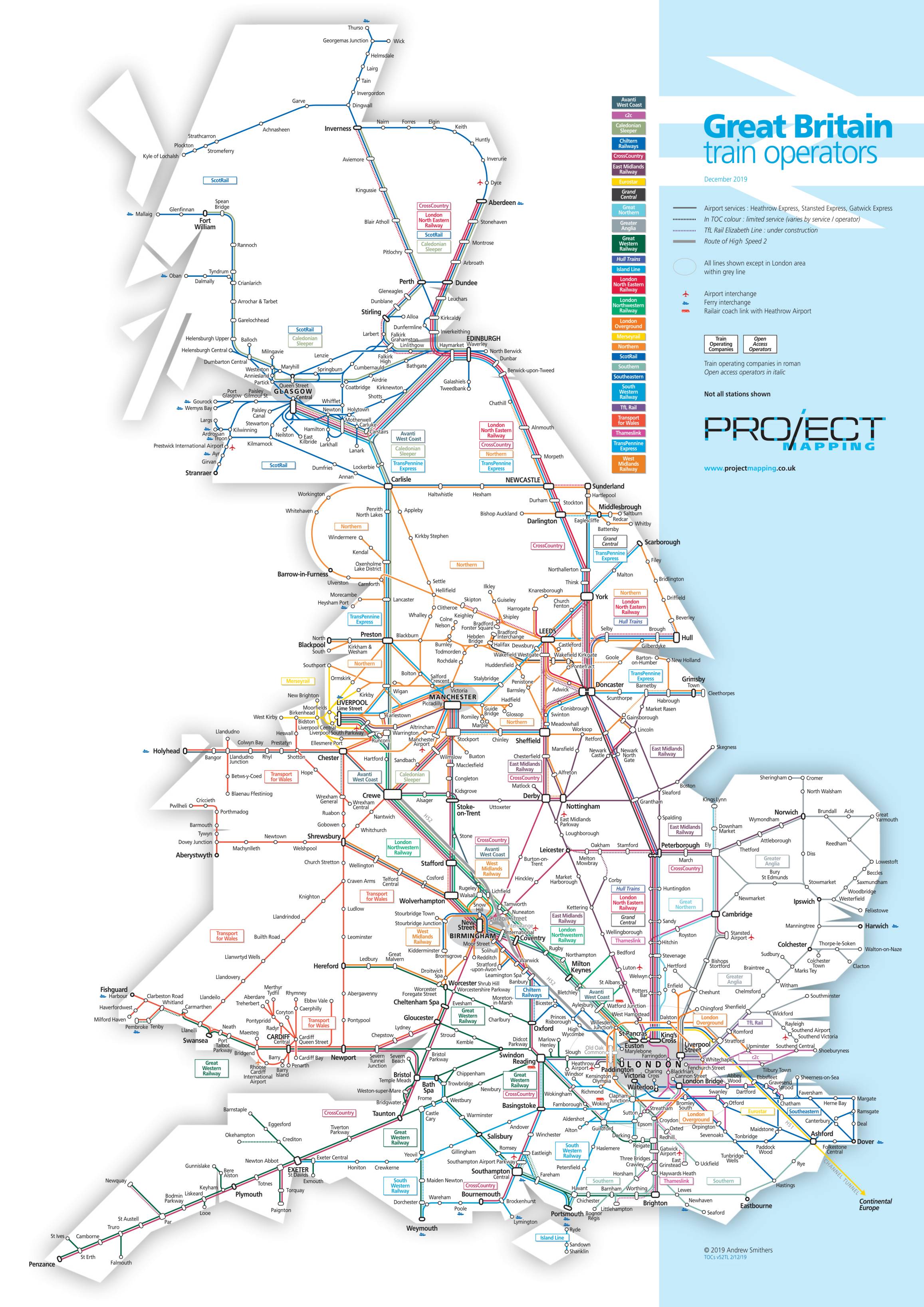
https://www.ianvisits.co.uk/blog/2019/08/20/taking-a-look-at...
On the redevelopment of Euston station:
> Building not just more platforms for HS2, but critically, the extra tunnels for those trains to use shifts intercity services to the HS2 line, releasing lots of capacity in the old tunnels for suburban services. If that doesn’t sound too important, then where’s the UK’s most congested train... it’s the 17:46 out of Euston which carries more than twice the number of passengers that it’s designed for. When completed, HS2 is expected to more than double the number of seats out of Euston station during peak hours.
It seems building HS2 is only part of the cost. A lot of it is also paying down "infrastructure debt" that hasn't been touched for decades.