I'm not sure why this is presented as some new thing, or a gotcha or whatever this is. We've known about it for months... And IMO, it's a positive change although it does sound a little weird.
> They even give you a dialog prompt now to inform you
slightly tangential, I hate being informed of things when I try to do them. I'm in a hurry, I don't want to read all about something now. I wish the dialogs had an "email this to me, willya?" selection, with an opportunity to decide the long term setting that I want.
We added loads of genuinely useful new features to our SaaS app over the past year, such as the ability to mute notifications, quick user-switching with a PIN, and non-exclusive user role membership, and more - despite mentioning this in our monthly user newsletter we still get peppered with support emails and feature-requests for things that already exist! Additionally our feature-usage data showed that users just weren’t using them.
After we added a forced (but only 15 second long) new-feature-tour those support tickets evaporated and user-satisfaction went up.
Gotta use tough-love, it seems.
——————
Users are weird - we have a bog-standard “user menu” in the top-right corner that’s got the usual visual-affordances and opened by just hovering your name and avatars - with menu items like Logout, Switch User, Dark Mode, etc - but to our surprise the vast majority of our users simply never explore the software.
We considered it, but (in this case) the application's use-case is on shared/communual "front-line" machines (hence why we added quick-user-switching), so even though ostensibly a single, human user is logged-in, we honestly don't know who is actually using the machine, and some other user who is just borrowing a machine could easily dismiss a tour/onboarding intended for the actual user who is logged-in.
If you think that's bad, when we overhauled some incompetently written code (from a dodgy contractor before I joined) that stored passwords using reversible-encryption (ARGH!) - which was for a "feature" that allowed tenant-admins to reveal their own users' passwords (WTFBBQ!) - and switched to using correctly hashed+salted passwords we had dozens of support calls from angry/frustrated (and yet unsophisticated...) users who said they were no-longer able to login because they never bothered to remember their password, they'd just ask their tenant-admin to tell them their own password (aiaaiaiiaiaiia) and now they couldn't do it anymore. We asked why they couldn't use the forgot-password page or a magic-link to login and they said it doesn't work because they all used fake e-mail addresses for their users (*dies*) (these tenant accounts were all set-up before things were fixed, and accounts with invalid/unverified e-mail addresses were just grandfathered-in).
We do also support OIDC (we are our own IdP, as well), so to try to make things easier for our users we'll be adding O365/AzAD soon, with sign-in-with-Google (and maybe sign-in with Facebook... excuse me while I take a cold shower) so at least some users can dispense with having a separate user-account they need to remember details for.
...so things were awful, now they're just bad, and they're getting better - but things could always be worse: Our main competitor is an on-prem VB6 app that pushes data to a "cloud" (i.e. Internet-exposed) SQL Server running off a business/residential IP address with a hardcoded SQL login userID and password shared by everyone (all of their tenants!).
------------------
...this is what the LoB software world is like. There is so much room for improvement everywhere - but all the competent uni grads join some glamorous FAANGMA company after school (well, I'm guilty of that myself...) - but I wish they'd consider un-sexy LoB software: it pays much better than FAANGMA provided you're competent and know how to negotiate. I think the LoB area gets a bad rep just because it's generally where (for want of a better phrase) less-talented people end-up which brings down the average total-comp.
Yeah. We’re not in any big company - far from it. If this was the last decade I guess we’d be called a Micro-ISV. I don’t know what the current trendy name is though.
For real, VSCode is one of the "champions" of this. Yes, I'm sure the new Golang extension is very cool or that I need to setup this other module but for now I'm just worried about what I need to do
VSCode opens a page of content in an editor tab next to what you are doing. That’s pretty much as unobtrusive as it gets. You can just close it and move on. It’s just there if you want to and is a nice way to signal that it did indeed update as everything is pretty much automatic.
Also it’s very easy to reopen later which was the OP complaint against popups. Now that I think about it, VSCode is pretty much best in class when it comes to update content notifications.
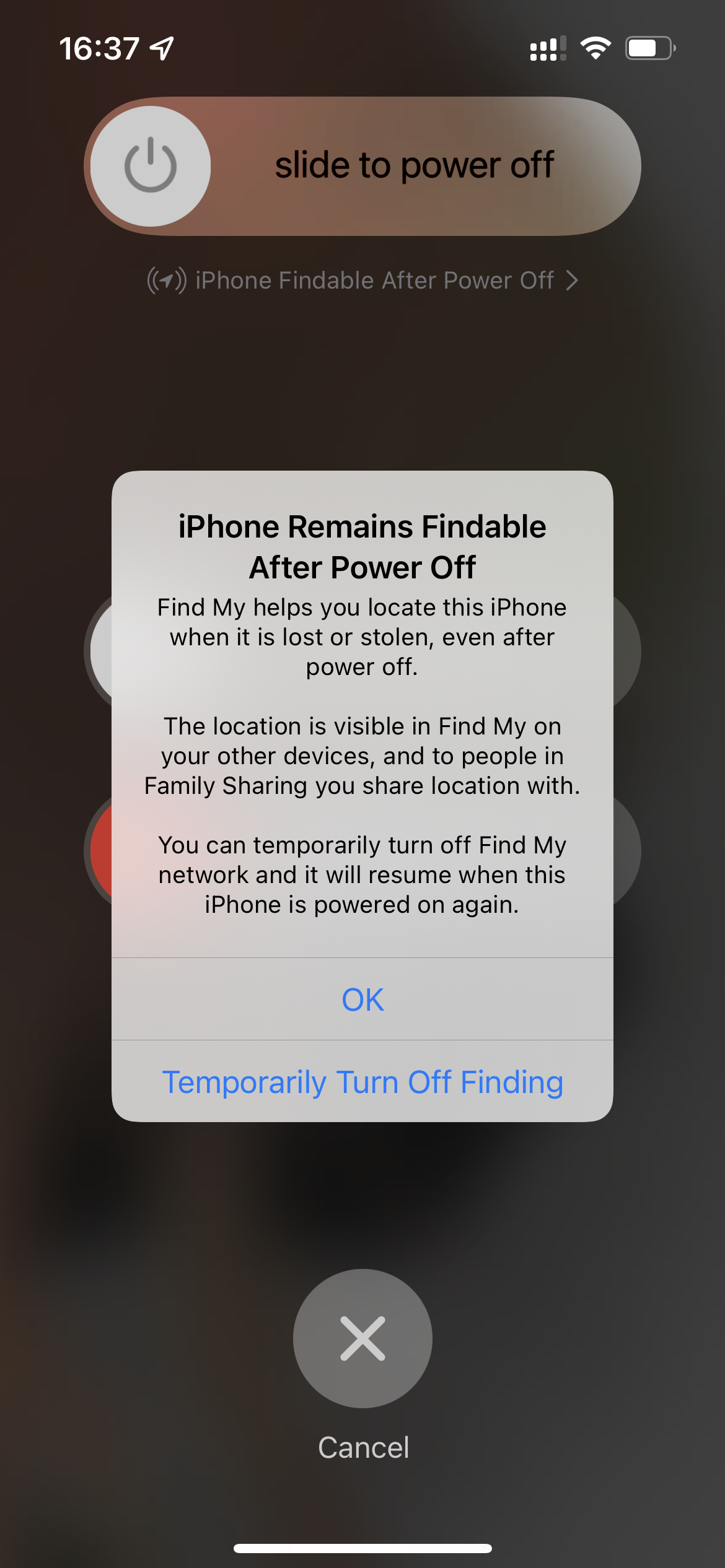
In this case, there's a bit of extra text that is clearly clickable (has the now standard arrow to the right indicating there's something more). Then there's a dialog box describing the system and two choices: OK, Temporarily Turn Off Finding.
The modal dialog could be replaced with a toggle on the same screen as the power off slider in place of that text, and maybe one day it will be. But right now, since the feature is novel, it's probably worth it to have the extra bit of text so people know what the options are that they're selecting between. As far as slowing you down, you're shutting down your phone. If you only want to temporarily turn this off, yes, you're slowed down by about 0.5 seconds But if you are really concerned about this feature you've also had opportunities while using the phone to disable it so that it is permanently off in which case you can just use the power off slider and be done with it.
We ran an A/B test on some 3-pane and 8-pane versions of these at my last job and on the long ones with a "dismiss" button IIRC it took our users something like 3.4 panes to hit it on average. The long ones without the dismiss button got people to view panes 7 and 8 a lot more often but there was a noticeable (albeit small) uptick in users who left the site entirely instead of finishing.
This sounds an awful lot like defences of hundred page EULAs: "So you made a decision not to read it...".
No, it was intentionally designed in a way which discourages reading. In the case of this warning, it's possible that it was unintentionally designed in a way which discourages reading, but regardless the fault lies, at least in part, with the design.
I think it's two-fold. Part of EULAs are just discouragement. But part of it is that the legal community doesn't do "simple and clear". Due to the weaselish twisting of words in lawsuits everything has to be airtightly formulated and that causes a bunch of legal terms and extremely explicit descriptions which basically makes legal documents unreadable for normal people.
Which also benefits the legal community by keeping them in a job, obviously. "Get it checked by legal/my lawyer" rather than just reading what you're signing up to is definitely a thing. I wish the legal system was more focused on clarity and common sense rather than the hard letter of the law.
One would think that a group of people so familiar with Latin would understand the potential consequences of this. That the masses were able to read Protestant literature but unable to read Catholic literature was one of the major factors that allowed the Reformation to occur.
Agreed.. You can kinda see the beginning of this. Nobody takes EULAs seriously. I mean, who even reads them?
The problem is that this was not done by a conscious decision but by a slow progression of a system. Bad actors getting away because of wording not being airtight etc.
Perhaps what could be done is enforcing the key points of legal agreement to appear at the top in clear language. We're already seeing some of such initiatives like Apple's privacy information section in the app store.
It's all about timing. My computer and phone are work tools, and I can't stand the things they do at an OS and app level that get in the way of me doing my work, because most often when I do it, I'm in a really big hurry to get it done. A simple dismissible notice of "hey we need to talk later about some stuff" and an easy place to view that queue would go a long way to improving this state of affairs.
As much as I agree with you, honestly, when are you ever going to get to that queue of messages? Even my email inbox is overflowing with the not-emergency messages, as it has been doing since 2006 or so.
Ultimately it doesn't really matter anyway. Unless you are the worlds most wanted criminal and Apple is working with the government to track you down via your turned off iphone. And in that case, you should have done your research to see this anyway.
If the average user blows past this message, it has no impact on their life.
From the referenced tweet thread about someone finding this out for the first time:
In other news I updated my phone to iOS 15 and put it down to charge last night. When I woke up it was hot, and my battery has gone from 100% to 15% since 7:30am. I gotta get off this ecosystem.
"My phone's battery life has suddenly become much worse" sure sounds like a major impact to me.
That has nothing to do with this change. It doesn't even seem like they had their phone turned off for this to be in play anyway. The most likely answer is that they hit a bug in the new update or that they placed their phone off centered on a wireless charger. I'm not sure why the general public should care about rare bugs in day one updates which get patched pretty quick anyway.
The turned off pings use an ultra low power mode similar to the airtags which should last months on a "flat" battery.
The Chinese, Russians or Belarusians wouldn't agree with you. There's plenty of people there doing "illegal things". Why should you care? You never know when something can become illegal in the future or the social equivalent of cancelling. You might have made a joke that's not okay in the future, criticized a leader, read a book, played a game, used a VPN...
Yeah, there's a reasonably visible message "warning" you of this, which has a prompt to turn it off.
I actually thought this was very old, added a year or so ago. I guess it got delayed?
I've had two phones stolen (right out of my hands) that were immediately shut down and sim cards ejected to prevent them from being tracked. While I'm sure this feature wouldn't help me get back a phone, I hope it does deter this.
And they may, but the effort to steal an iPhone has been increased with this, and the difficulty in recovering a lost (not necessarily stolen) iPhone has been decreased. It's a win for the typical consumer.
Yeah I'm baffled by all of the comments saying that this is great as an anti-theft feature. I don't know where people live that that's the case, but I sure as heck have never known police in the US to give a damn about $1000 property crimes. They don't care about $20000 home robberies and car thefts, even with strong video or other evidence. I can't imagine they're going to start chasing down criminals to get a used phone back unless it's for the mayor's kid or something.
I was visiting a friend in Switzerland a few years ago, and her bag got stolen right off the back of her chair while we were in a restaurant. (The guy was quick and sneaky; by the time I ran out to the street, he was gone.)
The restaurant manager called the police, and over the next 15 minutes we learned that the thief went on to try to rob the wrong person at another restaurant a couple blocks away. The intended victim held the guy down until the police arrived. The restaurant manager led us over to the other restaurant.
The police managed to recover nearly everything that was stolen, by going through the guy's pockets, and also doing a search in a nearby alleyway, where he had dumped my friend's bag and some of the less-concealable items he'd stolen from people. One thing (can't remember what) was still missing from my friend's bag, and the police took down information about it and told her who to contact to follow up in case it was found.
It was easily the best experience I've ever had with police anywhere (I live in the US but travel fairly frequently). I wish all police could be like that. (Granted, this was just a single experience with two specific officers; who knows if the rest in their precinct or even country are on average that good. But it was definitely encouraging.)
I recount this to suggest that in places with police that don't suck, maybe this sort of thing could actually be a decent anti-theft feature. But agreed that police in the US don't care. I was once mugged and had $3000 worth of stuff stolen from me (laptop and two phones), and the police clearly filed my report to /dev/null. Another friend of mine had her iPad stolen once, and she ended up tracking it down on her own (not the safest thing she's done) because the police told here there was "nothing they could do" even though she showed them the tracking information.
This actually reminded me of a couple positive experiences I had with police in Mexico. They weren't sitatuations where I'd been robbed so not totally analagous, but twice I dealt with officers that were very thoughtful and helpful.
Living in the US has probably skewed my impressions of police generally.
Wasn't my experience in Chicago. I was robbed (of my phone, at $12) and had my phone back within 15 minutes, including the time it took to call the police.
Your experience is not a pan-european thing by the way. Get your bag/wallet robbed in Barcelona and the police will just roll their eyes at you and give you a report for your insurance.
In my country, I've seen a person enter a police station asking for his phone, which he knew to be there because of a finder feature (not sure if it was Find my Phone in an iPhone specifically). The police must had taken the phone from someone who was caught stealing in a different incident or something.
I've had an iPhone stolen twice (both times it was my wife's actually). And both times I've recovered it using Find My. Honestly, it didn't even occur to me to involve the police. I just fired up the Find My app as soon as she told me the phone was missing, and I hunted it down. Confrontations ensued on both occasions, but nothing too serious.
I often see people here referring to their country without mentioning the actual country, i.e. they hide the interesting detail, which I find weird. Why not to write "in Iceland..." instead? Or is it a privacy thing or just some kind of modesty?
And here in America, I got literally laughed at by my small-town police force as a teenager when I went to them with the exact house my stolen bike was sitting outside of.
The Dutch police want to avoid that civilians 'play their own judge'. If the perpetrator and/or stolen object can be positively ID'ed this is a big plus for the public prosecutor to give a go ahead. What can happen then, is that the police try to buy the stolen good, catching the perpetrator red handed. This is the most effective path of getting a case succesfully put to trial. However, it is going to differ per local jurisdiction. Some Dutch police do have man power issues as well, just like some of USA has.
On a side note: I don't like the attitude of laughing at civilians/victims who the police officer is supposed to serve. Its a kind of negative attitude which devalues the victims interest (I don't like the word toxic but others would apply it here), eventually harming trust in police in the process which (long term) benefits criminals. And what I also don't like is when such is generalized on all police, all around the world.
Police in the US don't investigate any but very expensive property crime against individuals, either. And I don't actually know that they investigate very expensive property crime—I just assume they do. Certainly mid-five-figures of theft from multiple locations by one crew with tons of video evidence isn't enough to get them interested, beyond taking the report.
... unless your country is the US, in which case, yeah, true.
Yeah, I'm sure the police wouldn't check either. I'm sure it wouldn't help me get my phone back but (perhaps paradoxically?) I hope it at least is a bit of a deterrent.
Agreed. Of all the messiness in iOS's settings app, it's honestly pretty easy to find the setting to turn this off (iCloud > Find My > Find My network). The Twitter thread almost reads like someone who's trying to not understand what's happening.
Not to mention the fact that there's a reminder of this setting every time you turn your phone off, which can be tapped to disable this behavior.
I tried this and it specifically didn't work for me. I also coudln't find where it was (I was expecting in the privacy > location settings). Eventually found it, but I was surprised at how much I struggled.
That's like someone saying that fire is hot, but you respond with you can turn down the flame on the stove. While that may be true, you've completely dodged the original question.
pffft. you're taking things way too seriously my friend. i don't care how often it is/is not used, 5 levels deep is deep. it's just not well designed not that it's intentionally hidden. your obtuseness to this fact is even more pathetic
The setting to tell my phone to turn all the way off when I turn it off is in under "iCloud" settings and is called "Find my network", and that's considered "pretty easy to find"?
What did the parent poster mean when he said "it's honestly pretty easy to find the setting to turn this off (iCloud > Find My > Find My network)"? Or are you disagreeing with him that it's "pretty easy to find" in the settings?
I'm generally of the impression that any phone with an unremovable battery is never truly "off" at any given time, unless the battery is totally damaged.
PS: I like phones whose batteries are removable, currently use a Nokia Android with a removable one. One advantage is that when the phone drops down, it disintegrates, frame from battery, decreasing the overall impact on the phone.
I remember using a low-energy bluetooth scanner and noticing a strange mac that shouldn't have been present. I really wanted to know wtf was broadcasting it. I searched and searched looking in stupid places. Eventually I settled down and began thinking clearly and looked at my speaker. Yeah, it was as off as the power button could make it, though still on. A good toss across the multi-acre yard and the signal faded accordingly.
Data point: I'm an iphone user of average intelligence and attention span (you'll have to take my word for it), and I'm sure I saw this dialog. But if you'd asked me five minutes ago whether my iphone was findable when it was powered off, I'd have said "of course not, that's what being powered off means". So, either it's my fault for not having an eidetic memory about system dialogs I saw 11 months ago, or it's not a great design.
The "slide to power off" prompt literally says "iPhone Findable after Power Off >" right under it every time, but 99% of users will never see it or care about this feature because no one ever turns their phone off.
But if you're one of those few people who does turn the phone off, it says right there, and you can tap on it to shut down to unfindable state this time instead.
Note that it requires a passcode to disable, which is key to this feature. If someone steals your phone it will remain findable unless they open it up and pull the battery.
14.8 won't be findable after power off, it's an iOS 15 feature. When "turned off" it can maintain an occasional bluetooth beacon like AirTags which other iPhones pick up.
Running 14.7.1 and the Find My network setting says that it will enable my iphone to be found when turned off, but the power off screen does not say anything about that.
Hard reset doesn't have anything to do with this since it turns back on afterward. As far as letting the battery die, I think it's going to be much more common that someone loses their phone, the battery is dead, and this helps them figure out "whoops, I left it at the bar we went to after dinner."
The power reserve for this only lasts a few hours, but if you don't want that feature you can turn it off.
>It literally isn't spying on you, it's allow you to find your after you've lost it.
almost no mobile device has a feature that is 'literally spying on you'.
the problem is when the devices have so many features that they can be easily turned into a consummate spy device by any nearby paying agency.
in other words : no mobile device is spying on you, but the people who control them definitely do, and they're often willing to sell the rights to do so to groups that are poorly vetted -- using a device with less capabilities necessarily gives the controlling party less options by which to gather data for whatever reasons they may be compelled to do so.
so.. the phone, lacking sovereignty , does not spy on you; but it's a big leaky gps/imu-enabled microphone camera that sits in your pocket or purse all day, and the list of groups with access to that leaky data-pipe increases every day with little concern and little reform regarding data retention policies and ownership rights.
I’m not entirely sure what your point is here. Clearly an sophisticated electronic devices full of sensors and radios can be used to track you, I don’t think anyone on HN disputes that. But that issues seems rather orthogonal to topic at hand.
Unfortunately iOS is filled with call-homes to apple servers with all sorts of telemetry data. You can "turn off" exact lat/long coordinates (location data), however your cell provider can triangulate your position and apple can triangulate via wifi/other Apple products. Read about how Airtags work.
I think they knew that, as they mentioned they could get the location that way. Though Apple can’t use AirTags to triangulate positions, since they are just uncorrelated random number to Apple—only once they are decrypted locally can your device find the location of another device that it knows about.
The other way to be aware of by which websites do get location though is from GeoIP.
Also worth mentioning: express transit pass/ student card system still works after the phone has switched itself off (i.e. reserve mode) It'll work for up to 8 hours until the phone is completely out of juice.
Because frankly a lot of us didn't know about it. Not everyone is aware of the same things. Some of us think that powering off a device should power it off.
i'd like to be able to store a phone on the shelf with a properly conditioned battery, to be able to disable the radios during flight, or frankly anywhere else I don't want to be located.
Interesting how different people have different desires.
I went to settings where you can toggle Find My Phone. It doesn’t say there that it’ll be findable even after I switched it off.
I went to next screen it doesn’t even say it there.
Then I clicked on “About Find My & Privacy..” it opened a huge T&C kinda thing text screen and I read until 3-4 paragraphs. It doesn’t mention it there either.
So I think it’s a problem and Apple is anything but clear/straightforward about it.
Maybe they started showing the warnings recently, but this practice was in place for at least a few years.
I remember reading an article by a journalist who was on a trip and his iPhone died. Later he discovered it still logged his locations, not only when off, but when dead (I assume the iPhone is designed to shut off with some juice left)


I'm not sure why this is presented as some new thing, or a gotcha or whatever this is. We've known about it for months... And IMO, it's a positive change although it does sound a little weird.