- How much of the carrying capacity is eaten up by the batteries necessary to hit the range target?
- Would anyone operationally want to fly a 10,000 mile flight? Is speed a huge barrier for trying to do this in a single round the world flight?
- Is helium scarce enough that there'd be negative externalities for medical helium if they actually produce these in any numbers?
- What's the status quo ex ante here? I would guess you airlift relief supplies to the nearest safe staging zone using a herc or similar and then use chinook or similar to get directly to the disaster zone? Is there actually a problem to be solved here?
(I like dirigibles and electric tech, so I hope there are good answers to all of these that make me look foolish)
They reduce the planes use of Helium by it's shape and design, when the engines are turned off it's heavier than air and it will sink. However, Helium is a scarce resource. I don't approve of a billionaire fun ride between LA and Los Angeles taking up all the helium (which will leak out over time and may need top ups every time it departs).
I'm also, wondering if people (the demographic) have time to sit for long periods of time, they seem to value their time, and a private jet is faster.
Overall this is presented as an another green tech that will ensure carbon free travel. I see this as greenwashing a billionaire fantasy.
I could see it having the same appeal as a cruise liner. Anachronistic novelty travel where the craft itself is the main attraction and the destinations just happen along the way.
I feel that the main appeal of a cruise liner is that the trip is also part of the vacation. You can enjoy comedy shows, play in the pool, relax in the sun, drink, gamble, etc. It's like a mini Las Vegas that moves. Where as I feel this would be more like waiting for the ferry to get from point A to point B while there's also a bridge that's much faster.
With all that said, travel is not the purpose of the airship. It's to help humanitarian aid response and relief for areas that are difficult for planes and boats to access due to destroyed infrastructure.
Since I was a child it's been my dream to travel, slowly and low, in one of these over the tree tops in New England during leaf season, or through Fjords, or across beautiful countryside in France or Italy or wherever. I don't want to travel quickly and I don't want internet connectivity. I just want to slowly take in nature.
Heh, I go out of my way to ride on ferries. If you have time to spare, the Alaska Marine Highway (a ferry) is a very pleasant trip. But a Vegas-like experience on a cruise ship sounds like hell to me. For each their own I guess.
VIA Rail has tried to pitch the four-day trip from Toronto to Vancouver in these kinds of terms, I think in part to justify the big cost, particularly of a berth or cabin:
Every now and then I think about taking one of the long distance Amtrak trains. But I've always suspected the idea is probably greater than the reality. (And it's not inexpensive.)
>>I could see it having the same appeal as a cruise liner.
Except it won't enjoy the international law that is the core of the cruise industry. Cruise ships are essentially just resort hotels that don't have to obey wage laws.
Incidentally the deadliest airship crash of all time was a helium airship, the USS Akron.
Nevertheless, hydrogen does pose a real risk to the passengers in the event of an accident. In other helium airship crashes (for instance the USS Shenandoah), some people managed to survive by riding the debris down to the ground. And in some hydrogen airship crashes (for instance R101), some people managed to survive the crash to the ground, but subsequently died in the fire.
More airships were lost to poor weather than thermite paint or whatever other specific Hindenburg problem you're thinking of. Planes have numerous inherent advantages in this regard: They're faster, which makes weather forecasting and route planning easier. Smaller planes can land almost anywhere, but airships require mooring towers. Airplanes are more robust when left outside in the elements, and their hangers are much smaller and cheaper than airship hangers.
I think in principle, a blimp that could land on a field and stow its balloon rapidly could address these problems. But rigid airships seem inherently problematic; the fundamental nature of an airship (very big and very light) makes it susceptible to high winds, in the air or on the ground. I don't see any way around that.
I've talked with airship people about the helium question.
Basically, hydrogen is better. Hydrogen has an image problem because of the Hindenburg, but there are compelling reasons why nothing of the sort would happen again.
The idea is to regain airship capacity using helium, while it's still cheaply available from a couple natural gas wells, and switch to the better lifting gas in a friendlier political climate.
The other advantage of using hydrogen is (in an emergency fuel situation) being able to slowly 'rob' the ballast ballon for fuel for use in either the motive engines or an ICE genny if the solar setup failed for some reason or you needed 'hyper-drive tubo-boost' levels of power
> Would anyone operationally want to fly a 10,000 mile flight? Is speed a huge barrier for trying to do this in a single round the world flight?
I'll take a crack at this: Since it is targeted towards humanitarian relief, it may travel to places without electrical infrastructure to recharge it. So, 5000 miles each way. Presumably charging takes a non-trivial amount of time, so in a time sensitive application like delivering medical supplies, there is also an advantage to not having to stop and charge.
That being said, I am also skeptical this is faster or more practical than using traditional cargo aircraft and/or helicopters. A C130 doesnt need much of a runway to land or takeoff.
I think a lot of the benefit is not necessarily about flying continous long distance flights but being able to carry lots of weight and to easily hover and stay in a general area. Like a base of operations for the military for example.
There isn't infinite anything on earth. Earth is finite. And running out of resources that are economically viable to access is effectively the same as running out. (Also, helium is a by-product of crude oil production, and so its production has some rather dramatic externalities.)
The earth is very deep. We are only mining the very tip of it. There are thousands of miles of unmined resources down there. That’s not infinite but a lot. And sure, we can’t get to it today, but who knows what 100 or 200 years will bring.
But oil at that cost provides a huge land-rent income to the Saudis when world (market) oil prices top $50, $100, $150, $200, ... bbl.
KSA's extraction price remains $15. The rest is pure profit to them.
(Discounting the hundreds of millions of years of geological accumulation and transformation which created the resource in the first place. See "Burning Buried Sunshine" by Jeffrey S. Dukes, 2003. https://dge.carnegiescience.edu/DGE/Dukes/Dukes_ClimChange1.... (PDF).)
Yes, you are correct. Contrary to gold, however, which is largely useless and ornamental (aside from some marginal use in microelectronics), helium is necessary for a large amount of critical medical infrastructure, as well as research at cryogenic temperatures, superconductors, etc. To see helium steeply rise in price according to supply and demand would spell disaster for many of these applications.
Moot. With natural resources, it's entirely about the cost of recovery. Nothing else matters. Who cares the core of the Earth is all iron, if it's eternally unavailable? What matters is $/ton.
The US built a couple of very large rigid military airships in the 30s (intended to carry small airplanes!) and then never built any large airships of significance again. So, yeah, kind of a meaningless claim. The proposed airship is 180m long; USS Akron was 239m.
Neat side fact about the Akron Airdock[0]: at some point in the past each 600-ton door on the end needed a drive replacement. My grandfather's company was called in to fix it, but the cost to replace it to spec was too costly. I don't recall the exact specifics but the engineer on the job told me the original opened the door in under 8 minutes. To lower the cost of the replacement they put in a smaller drive but it takes something like 20-30 minutes to open the door. I suppose this video could be used to estimate the total time[1].
Finally, after almost 100 years, we are overcoming the trauma caused by the incident of the Hindenburg[1]. I am really looking forward to what opportunities it may open.
Those opportunities would be limited. Given that commercial airlines operating airplanes were in it's infancy before WWII, there was a potential market for rigid airships.
World War II changed all that. The Hindenburg wasn't just a commercial airship, it was very much used as a propaganda prop by the German regime in the 1930s. By the time of the Hindenburg disaster, the market for commercial flight was about to be stymied by the War.
The disaster didn't just create trauma, above all it marked the end of an era of relative infancy in human flight. And even at the time, competing airlines already were building long range aircraft such as Pan Am / Boeing's famous "Yankee Clipper".
Technological advances and massive investments during the War favored airplanes such as we know them today. In the late 1940-1960's, airplanes allowed for cheap and fast international travel which could easily be scaled upwards. By that time, few if anyone wanted to spend 9 days crossing the Atlantic in luxury if traveling from London to NY could be done in mere hours.
I don't see airships ever taking back a significant chunk of that market. If anything, they might appeal to certain niches. Maybe in the same vain as one could - even today - still ride parts of the Orient Express in style.
I don’t think airships are as bad as it may seem today. Perceived badness is a lot due to lack of networking effects which airplanes enjoy today. There is infrastructure for landing airplanes everywhere. If the same had existed for airships I he economics and practicality of using airships would have been very different.
Many of the problems that existed with airships in the past are solved today. Weather forecasts are much better today. Elevation can be controlled better with compressors which can expand and reduce volume of ballonets on demand combined with propellers which can be more fine controlled and directed to cause lift of descent.
Not to mention access to a plethora of advanced materials they did not have in the 30s.
Most importantly we are in a green shift. When airplanes took over nobody cared about CO2 emissions. Airships can realistically run using electric motors driven by batteries or preferably fuel cells. For airships volume matters less, so you can more easily have large quantities of hydrogen in the ship. In theory you could use hydrogen as lifting gas and fuel.
The dangers of hydrogen is somewhat overrated. Hindenburg was about paint coating more than hydrogen. We also got much better techniques for handling it yet today. You can have an outer shell of a different gas e.g.
During WW1 German airships got frequently fired on without causing any them much damage. They had to fly close with incendiary grenades to take them out.
I also used to 'sort of know that' and then I came across something on YT about the updraughts and air turbulence etc. Can't find the clip I saw but this link says pretty much the same.
"A popular myth claims that the top of the Empire State Building was meant to serve as a docking station for dirigibles, but the building's owners say that the story is just hot air."
> Without doubt, the tallest mooring mast ever designed was the spire of the Empire State Building which was originally constructed to serve as a mooring mast, although soon after converted for use as a television and radio transmitter tower due to the discovered infeasibility of mooring an airship
They did build the Empire state building with a mooring mast and a a lounge / ticket area and a way for the passengers to get on the plane. But it was purely speculative, and though they took publicity photos, they never used it(remember: there were only a handful of commercial airships).
There used to be a commercial heliport on top of the Pan Am Building over Grand Central Station. The first helicopter crash that sent chunks of metal flying 600 feet down to streets with huge amounts of foot traffic permanently closed it. I'm sure something similar would have happened had the Empire State Building 'port' actually been used.
Unlike the Empire State Building airship dock, the Pan Am heliport was an actual and working mini 'airport' with regular scheduled flights / pick-ups-drop-offs for years.
This is also why none of the companies building powered lift eVTOL aircraft like Joby and Lillium are unlikely to achieve mass market success. Even if they can achieve FAA certification, there aren't enough places to land in dense urban areas.
It doesn't look like that kind of mooring would be up to the modern safety standards, especially when you add high winds that are common at the top of skyscrapers.
> Without doubt, the tallest mooring mast ever designed was the spire of the Empire State Building which was originally constructed to serve as a mooring mast, although soon after converted for use as a television and radio transmitter tower due to the discovered infeasibility of mooring an airship, for any length of time, to a very tall mast in the middle of an urban area.
The picture below has an airship getting flipped on its nose by a gust of wind while moored to a tower.
It seems to me that airships really need two mooring masts. One at the front and another at the back. Maybe the one at the back flips up to lock on once the one in front is secure?
Tbh, it'd probably be inherently safer. The ship should be easier to control because the air at the top of a skyscraper is likely to be less turbulent. And if there is an unexpected down draught, then there is a lot more leeway before the ship and its compliment get smashed into the ground.
Ground handling and docking is one of the main, and fairly frequently fatal, causes of airships accidents, see https://en.wikipedia.org/wiki/List_of_airship_accidents. Fwiw mitigating is definitely possible. But it requires specialised docking equipment to be available anywhere they are to set down. Which is why I suspect they'll make rather better Bazillionaire play things than humanitarian aid delivery mechanisms. They are very cool though.
That would be very risky: those monsters aren't friends with the wind. Any glitch and a lot of power gets applied to that building. Another glitch and a large frame falls down on the street.
You can read reports of Nobile airship trips. And wind could delay trips by days.
Apparently not too risky, since, as the parent pointed out, in the early part of the previous century, it wasn't unusual for tall buildings to be used for airship docking.
The Empire State Building mooring wasn't a one-off. There were many others. What is now the InterContinental Hotel in Chicago was one.
Thank you, I will look it up. I wonder what the success rate was for those, I thought they sometimes went to backup locations.
I read accounts of using airships in the exploration of the North in the early 20th century and I got the impression that they often dropped ropes in a clear spot away from the exact landing point and were led by a landing team to the final docking, which would be hard to do in the middle of a city today.
That's because human lives were cheaper back in those days. The problem with docking a giant people carrier above a densely populated area is that you have even more lives at stake.
We send airplanes over densely pack cities all the time. We even let the rather pointless Goodyear blimp do so. Docking an airship would be safer if the area beneath it was completely clear such as a river, but in normal wind conditions it isn’t particularly dangerous.
Goodyear blimp only flies in relatively good weather. On airplanes over cities though: compare the cross-section and the corresponding force exerted by the wind on a modern jet and a blimp. Jet engines can compensate for wind gusts that would make landing an airship in a tight spot hopeless.
Airline landings really aren’t very precise which is why runways are so wide.
In terms of wind, airships with the right control systems can be designed to hold position in 50+MPH guts. That takes a lot of power and rapid response, but modern airships can do 110kph and presumably commercial adoption would need higher speeds.
> In terms of wind, airships with the right control systems can be designed to hold position in 50+MPH gusts. That takes a lot of power and rapid response
I am not sure: countering the change in direction seems very hard. But I do wish luck to those who are working to push this technology along.
> modern airships can do 110kph
That is how fast the Zeppelins of 100 years ago traveled: cruising speed of 76 mph.
Any flying machine has some maneuverability when flying PASS a populated area, even in emergencies. If you just dock above the area at all time, it will increase the risk immensely.
Modern air travel outside of business class and select airlines like Lufthansa is a far cry from the luxury and glamour of the Pan Am days. Maybe people will pay to take a cruise among the clouds.
The question is price. Air travel 'sucks' but has also become a lot more accessible, even long haul. If an airship takes 4 days and costs the same as business class on a regular plane I think many people will just business class.
There's a market for cruise ships... as a destination. There's basically no market for ocean liners. There's, what, one left?
Perhaps people could be convinced to take an "air cruise", though it'll never have the amenities of a ship, but as transportation there's very little room for slower and more expensive.
>Modern air travel outside of business class and select airlines like Lufthansa is a far cry from the luxury and glamour of the Pan Am days.
Not really. It was comfortable if you had first class seating--at a price above today's business class. But the first class lounge was fairly lightly used for the most part and became business class seating when that level of service came in. While airports are worse in some ways because they're often so crowded, modern international lie-flat business class seating is more comfortable in general--and there are more entertainment options--than first class on Pan Am was.
Lie flat does not exist for those of a normal height if you're talking about the luxury pods. Those business class sleepers are tiny and you will have to crook your knees.
I'm six foot and am pretty comfortable in them. In any case, they're more comfortable (even if you don't put them all the way down) than old first class seats--which were basically like the seats you get in most domestic business class today.
First, did not mean to offend people shorter. If that was how it was received, allow me to give my full apology. I'm sorry.
Given your stats that you're provided and I'm choosing to assume are true, then I'm abnormal but it does not change my experience on average. Hopefully the increasing obesity issue will cause some ancillary changes that may benefit tall people at the same time some day. At least let me pay for it, you know?
The big difference is that back in the day we had the interstate commerce commission establishing a minimum ticket price so that airlines didn't have to engage in "ruinous" price competition. Everyone had to pay what would now be business class ticket prices but everybody got business class service because that was the only thing airlines could compete on.
Appropriate taxation on fossil carbon could make a difference. Flying in kerosene-fueled planes should be made a lot more expensive than any alternatives.
> I don't see airships ever taking back a significant chunk of that market.
I would agree, not without a change in the market's parameters.
Environmental parameters coming into play can usher in such a change, though - I'm thinking of the lower carbon footprint of an airship compared to that of an airplane, that could push a change through.
I'm all for airships too, to be honest, as long as they are so cool and spacious as the one in Indiana Jones.
It seems like we should be able to make a solar cell light enough to cover the top of an airship and use electric power. Most solar aircraft don't make sense because there isn't enough surface area to get a minimum amount of power to keep the aircraft aloft. Airships don't have this problem. The issues are weight and expense and being limited to operating only during the day. Cloud cover isn't a huge issue, you can rise above it.
To be fair, nothing can compete with rail on land, but replacing trucks might be a nice idea, especially for international hauls, as there would be no extensive border and customs check in every country on the way.
It wasn't actually the Hindenburg that was the problem. It was that they were simply lost the competition in the market. They are just not really viable for 99% of applications.
They go into reasonable detail about where this trade-off makes sense (e.g. deliveries to intermediate warehouses in Alaska), they're not suggesting to replace all other transport with blimps.
Deutsche Zeppelin-Reederei has been going for 21 years now. It's the one bright light in the sea of airship projects. They're not exactly aiming to take over the world of aviation, though.
The lifting power of hydrogen or helium is about 1kg/m^3. This means as you scale weight up the size of your envelope grows quickly which greatly hinders manoeuvrability. And obviously the increase in envelope size means you need more structure and systems (propulsion & al) which are heavier and reduce your useful payload.
actually when now I start to think self flying zeppelin moving cargo containers slowly using electricity would be pretty cool. First you could start with windmill blade transportation and then move to other stuff.
Yeah, you can maximally lift the weight of the air you're displacing, right? That plane can carry 124000kg. Air is about 1kg/m3 at sea level, so that requires a balloon of 124000m3 (assuming the balloon and gas weigh nothing). That's a cube of 50x50x50 meters under optimal assumptions.
The niche use case I see for large airships (aside from pleasure rides) is deliveries in remote area with no infrastructure. For example delivering a big generator in Alaska.
In such use case, the comparison should maybe be against large transport helicopters.
> LTA's goal is to build huge airships to provide humanitarian aid in places where conventional transportation can't reach, such as in the aftermath of a disaster. (...)
"We believe that lighter-than-air technology has the potential to revolutionize humanitarian relief efforts with its ability to reach remote locations that have little or no infrastructure," Weston said.
I don't really understand how these are meant to help - they are extremely slow and can't carry very much weight. Surely airdrops from conventional planes would be more effective even if there is no infrastructure for them to land?
I'm trying to think of a scenario where this would actually be more beneficial than other means of transport.
Agreed. In the humanitarian scenario in a war zone, an airship just looks like a very big, very visible target. I don't understand this use case, except if you consider that humanitarian corridors are always respected in warfare but then it's just being naive.
But the article doesn't say how fast it can travel, which is extremely important in reaching disaster zones. Even if you're travelling from, say, Miami to Haiti is 1000km, so I guess it would take 30 hours? But providing aid to Tonga after the recent volcano seems unlikely with this airship.
Yeah, I'd take an osprey or helicopter for that use case. People w/out infrastructure usually need things fast. Or maybe https://flyzipline.com/ which uses drones
If we’d account correctly for airplanes and boats for the enormous emissions they have, than I think a full electric slow floating airship like this would be tremendously beneficial. However, for it to be economically feasible it also oughtta have similar subsidies like planes and ships have with their zero emission taxes.
Ironically, this vessel is being built in Akron, and the loss of the USS Akron was a dirigible incident that resulted in many more deaths than the Hindenburg.
This is a cool project, but there's been lots of abandoned airship projects (commercial and military) since the 1930s. Have things really changed since then? No new technology really solves the main issue that they're fairly slow, don't tend to work well in bad weather and can take a lot of infrastructure to land safely.
I'm not an expert but for disaster relief a few military cargo planes could be refuelled midair and drop 20 tons of aid on parachutes to most of the world fairly quickly.
The Americans famously evacuated >800 people out of Afghanistan in a single C-17 flight. Airships could be useful though if they can land "anywhere" (on the other hand, a single Mi-26 helicopter can also carry 90 people, and probably many more if crowded in the same way as that C-17 flight).
The Boeing C-17 can absolutely carry people. It’s designed for paratrooper operations as well as cargo. As noted, you can cram hundreds of people into one of the goal is fast evac not comfort.
That’s so cool… cruising in style silently… It’s so different than either land traffic over road or rail or “must move forward or falls down” rapid air transport.
Some have already called such airships the yachts of the future.
There will obviously be problems involved as numbers increase, maybe we can control them in ways we failed to consider on other transport lifestyle adoptions we’ve done.
Musk may be an incredible prick on Twitter and be a terrible boss to get orders from, his vision gave us Tesla and Space X, both ground breaking and needed developments. He is a man of vision, not a manager or people person. And his vision is limited to technology, not economics or politics. But if you're that rich, you can come to think that you know it all.
While Tesla existed before Musk joined it, it also had zero sales — Musk was part of the series A funding in 2004, their first public prototype was 2006, Eberhard was asked to step down in 2007 and did so Jan 2008, the first actual delivery Feb 2008 — and also electric cars were a joke at the point Musk invested in Tesla (the hype was hydrogen and ethanol to be the green fuels of the future). As 99.7% of the market cap gain happened since 2010, and therefore under Musk’s leadership, I definitely count Musk as more relevant than Eberhard (although even then, organisation and salesmanship is not enough by itself, but I’m not going to get sidetracked here into means of production).
SpaceX, however, I believe was literally founded by Musk.
Pretty sure Elon founded SpaceX himself. If you have a good source for the claim that it existed before he came along, you should take the matter up with Wikipedia.
If 90s Gates had Twitter, that would have been a sight to see…
People think he’s just a nice guy philanthropist now and forget he got there by being an absolutely ruthless, cutthroat monopolist.
Rockefeller literally had a camp of union organizers machine gunned and hired thugs to set fire to his competitors shipments so maybe he’s not the best example, either.
He is also kind of awful for the medical research world, he has no qualifications to be a massive force in it (with his non-profit) and yet he basically distorts the whole field into having to agree to his terms because it is so difficult to advance in the field if the gates foundation shuns you.
As far as I understand, helium is a non-renewable fossil resource. So a sustainable airship design should be using hydrogen instead. The challenge is to make it safe.
Vacuum is the ideal. Taking the molar mass of air at 28.8g/mol at STP we can see a density of air at about 1.225 kg per metre cubed. Combined with the volume of the bag we have the uplift. We quickly find that empty flexible bags collapse with nothing to provide an atmosphere of pressure back out thus the compromise of low mass gasses. These still add weight to our vessel diminishing our carrying capacity.
I think you misinterpreted what the parent is saying.
He's saying that a bag that contains only vacuum would be the lightest, but as it contains nothing, it would just collapse into having no volume due to the atmospheric pressure. That would obviously provide no lift. As such, you need something in the bag that will fill the space.
>tech billions being put to good and original aerospace use
i wish they would put some of those money to adjust FAA rules for the modern development - drones, human carrying multicopters, and whatever others things may come if the rules become friendly for innovation
All this red tape keeping us alive! How dare they not let me put tons of material into the sky, let it move around as fast as I like and expect me to be liable if it lands on some toddler’s head.
Aviation is fucking dangerous. I know, I knew many private pilots of experimental aircraft growing up, some of which died in accidents.
One guy died when his seat slid backwards while climbing out from takeoff causing him to pull back on the yoke and cause a stall. This is a stupidly common way to go.
Another died when his twin lost engine power on one side, again during takeoff, and he spun into the ground.
The list, unfortunately goes on. Neither of those particular two on the list died in experimental aircraft, although the pilot of the twin did survive an earlier crash in an experimental during landing, where he misjudged the time it takes to spool up a jet engine.
Do not take private companies putting things I to the sky lightly.
in particular because many aspects of it is technologically half a century behind. Stone age regulations prevent any meaningful advancement. It is like all the cars would still be manual transmission, no ABS, nor traction control...
>pull back on the yoke and cause a stall
VTOL multicopter wouldn't have such a stall
>Another died when his twin lost engine power on one side
Instead of cemented in time by regulations twin, having say 10 electric engines would mean that loss of one would result in just small automated readjustment of trust/power distribution.
Regardless of how advanced technology becomes, flying objects have inherently more momentum and since momentum is based on velocity squared, the strictness of regulation of flying vehicles should never be less than an order of magnitude more than ground vehicles of the equivalent weight.
speed/energy and reaction time of human or control machinery dictates separation distance. Thus drones for example can hover much closer to each other than say a separation distance between human controlled cars doing 90mph on highway.
Most of the new aircraft development would contain a lot of automation to the point of self-flying. The dense network of automated traffic control for such new aircraft would be another thing that only billionaires could really do. That would allow to take out of equation a lot of human errors that make current aviation dangerous.
And when the automation fails or the vehicle malfunctions who will take on the liability?
And the liability is inherently far greater than ground vehicles.
For example, right now it’s practically impossible to accidentally drive a ground vehicle, certainly not something less than a ton, into highly sensitive places like the pentagon/nuclear weapons storage facility/military base.
But it’s very easily imaginable that an automated aircraft less than a ton could fly itself into such a place, accidentally or intentionally, and cause a serious kerfuffle.
Or to put it another way, it’s thousands of times more costly to protect airspace from intrusion than ground space.
To cover the possibility of the owner being unable to pay out to cover the costs of disruption, liability insurance similar to car insurance would likely be mandatory, just thousands of times more.
If flying vehicles became deregulated and instead had a mandatory minimum insurance requirement for $1 billion of liability then it’s effectively the same. Because that’s the realm of very serious folks with large legal teams anyways.
Imagine that you have to explain to drone pilots that even a very small drone is completely unacceptable in an airport vicinity. Yes, your 0.5kg drone can seriously damage the compressor of an engine!
GP's and parent's strawman fallacy based line of argument reminded a video where Putin was explaining why it is so hard to get a protest permit in Russia - "Imagine if your protest happens in front of a children hospital, and thus it can block a live saving delivery."
out of interest, in the hypothetical situation where drones are allowed near an airport, and a kid tries to film a plane landing and accidentally takes out a plane engine, doing 10s of millions of damage, who do you think should be responsible? Would insurance be required for things like this?
why would be drones allowed near airports? I mean, of course, in the future with drones integrated into automated traffic control where it makes sense, and it would make sense in sensitive areas, there can be imagined a need for the drones to fly near airports, yet today why everybody brings airports up when there are huge swaths of other space where drones and other stuff could have been flying if not for prohibition?
But there are lots of cases where people fly cheap commercial drones around an airport, and that is completely unacceptable. It could easily result in a criminal charge and even prison time.
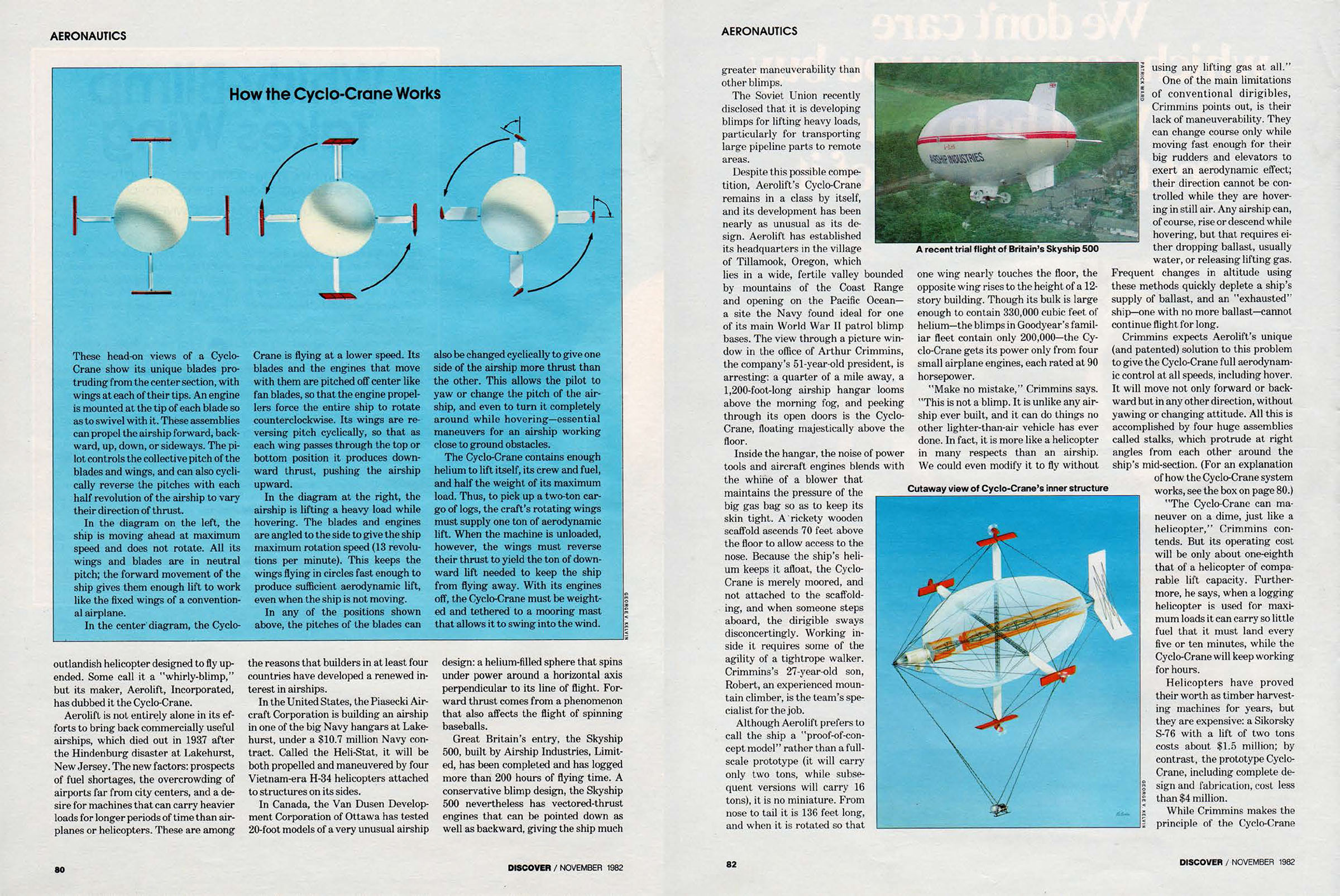
Basically an aerial crane which solves the buoyancy problem by spinning the whole thing like a helicopter. It's neutral by itself; if you want to pick something up, you increase rotational speed and generate lift with airfoils.
I saw this thing as a kid on a trip through Tilamook OR. Seemed really neat, though I'll bet it was tough to control with early-80s electronics. It would be fun to build a hobby version out of drone parts.
Reminds me of Cargolifter, they tried something less ambitious and failed... but that was 20 years ago, at the very height of the dot com boom. Better luck to the Pathfinder 3 team! It would be amazing to see airships revived.
This is being built in my hometown. That hangar is amazing every time I have visited it. There are even stories of it raining inside and having it's own weather systems [1] . Really great to see them building more blimps again, and pushing what has been done before.
So, going blue-sky big-picture here, the long-term appeal of airships seems to be in transoceanic travel alternatives to heavier-than-air craft.
I'm starting to think that transoceanic trains might actually be a more viable alternative. There's been some very preliminary exploration of this.
It turns out that for several heavily-travelled routes, the water distances involved are actually reasonably short. Most notably the Bering Straight link from Alaska to Siberia, 82 km (51 mi) wide at its narrowest point.
Traversing the Atlantic would be more formidable, possibly a multi-hop bridge from Newfundland to Greenland to Iceland to northern Scotland. Other links include the Timor Sea (between Australia and Indonesia), Gibraltar, and the southern Atlantic crossing from, say, Recife, Brazil, to Freetown, Sierra Leone, about 3,000 km (1,900 mi).
Norway has proposed "floating tunnels" as a technological option to bridge fjords for vehicle traffic for its E39 coastal highway project. These might work for transoceanic rail links: tunnels would float deep enough beneath the surface to be spared wave action and collisions with shipping traffic, but shallow enough that pressures would be reasonable. Depending on speeds, even the longest crossings (3,000 km) might take from 15 to 3 hours (200 kph to 1,000 kph).
Costs and risks are of course high. The project might be limited to, say, automated freight transport initially. But it's not obviously impossible, and could prove an alternative to either slow boat or high-emissions aircraft for future transport and travel.
Screw propellers need a large mast with bending torque drives heavy & expensive connection to the fuselage.
Cables get twisted and have slow tilting mechanism issues.
I'm a little curious how someone becomes an airship pilot.
I understand that the core skills from airplanes would carry over, but how do you create the protocols and best practices for piloting a completely new vehicle that hasn't been flown in nearly 90 years? Do the practices from 90 years ago still apply?
Zeppelin and Good Year have been flying blimps and semi-rigid airships continually, there are quite a number of qualified airship pilots as a result.
As for transfer from airplanes, only somewhat. Airships have a lot in common with boats/sailing but really they are very much their own thing with their own set of constraints and difficulties.
Silicon Valley had a nice zeppelin from 2008 to 2012.[1] The CEO, who was qualified to pilot the thing, used to show up at steampunk conventions.
He said it was the best handling airship built up to that time, and he'd flown a few others. Steerable fans under computer control make those things far more manageable, and docking without an army of line handlers becomes possible.
Unfortunately, they launched a luxury tourism project at the beginning of a recession. Then, around 2011, the pride of helium doubled. It was just too expensive to operate.
Or some super electrically charged exotic condensator material which would keep away from one another by nature of charge while the charge also makes it keep away from the wall and keep the relative vaccum enclosing diamond tent aflaot.. a man can dream.. a man can dream.. Vacum with powder
These are but necessary early-generational craft, the descendants of which will be used to explore the upper atmosphere of the Jovian planets. And to mine them for helium and other gases, with which will then be used as fuel for airships on Earth, I guess.
I'm sceptical about the practicality and economics of large airships, but I'd love to see small airship 'yachts'.
Santos-Dumont's Dirigible No.6 [1] could 40km/h with a 12hp engine in 1901. It had a 630 m³ balloon (33m long x 6m diameter, total mass ~600 kg). With modern engines, materials, and modelling you could make a very comfortable and quite speedy 2-3 person yacht in that size.
> Pathfinder 3 will initially be powered by batteries, Weston said. But the goal is to have the helium-filled airship powered by hydrogen fuel cells, he said.
This is worth expanding on. There is a worldwide shortage of helium [1]. It's being aggravated by ongoing natural gas supply disruptions:
> The helium shutdown in Arzew is a result of high natural gas demand in Europe, due in large part to Russia’s invasion of Ukraine. Helium is found alongside natural gas in conventional wells. Algeria normally compresses natural gas into liquid form at Arzew for global transport by ship. During that process, it’s economical to extract helium because it liquefies at much higher pressures and lower temperatures than natural gas, explains industrial gas consultant Jon Raquet.
> But now, much of Algeria’s natural gas is being sent to Spain via pipeline, making separation impractical. The industrial and rare-gas advisory firm Edelgas Group estimates that liquefied natural gas production in key regions is down 30% from January, leading to a 10% drop in global helium supply.
And it's not like we're talking about just a little helium, either:
> ... Pathfinder 3, at 600 feet long and 100 feet in diameter, is designed to carry about 20 tons and be able to traverse as many as 10,000 miles using electric-only, zero-emission propulsion.
Running some back-of-the-envelope math, we can think of this as a cylinder roughly 400 feet long (to take account for tapering on either end) and 100 feet in diameter. That's 3.14 x 50^2 x 400 = 3.1 million cubic feet of He just to fill. It doesn't even account for ongoing resupply, testing, etc.
The US is the largest producer of helium at 77 million cubic meters [2]. With a conversion factor of 35:1, that puts the volume of the airship at ~ 886,000 cubic meters. So we're not talking about consuming all of the US production of helium, but it's not insignificant, either.
> The United States is the largest helium producer worldwide. In 2021, the production of helium in the U.S. stood at approximately 77 million cubic meters,
In a rigid airship, the lifting gas is usually contained in smaller balloon-like cells inside the frame, which do not fill anywhere near all the available space. Your estimate is probably considerably over, though your concern is still reasonable.
(EDIT: they're not called ballonets; ballonets are used to maintain pressure in a non-rigid airship.)
Isn't there anything else Sergey Brin should be spending his time and attention on? Google's free rein in its early years surely had a lot to do with the fact that Page and Brin were successfully marketed as nice guys who could be trusted to be responsible stewards of Google. However stupid the rest of the world may have been to ever take this on faith, it is still on Page and Brin to keep their end of the bargain now. Together they still control the company outright, so (IANAL) they can do whatever they want. Let's be clear: everything that is wrong with Google's products and services—or at least, everything that is reasonably obvious, fixable in a reasonably obvious way and can be fixed without really enraging the other shareholders, at the very least—is on Page and Brin personally, as individuals. And there are many such things. The fact that in-document search (search!) performs atrociously on large Google Docs, causing real difficulty for literally millions of people and organisations, is something that Larry and Sergey could fix but choose not to. The lads have clearly, some time ago, decided that the hard, unglamorous work of stewarding Google—Google!—is work beneath their dignity and below their abilities: that instead their talents are needed for other, more high-impact things, like playing with airships. That really isn't so, and the rest of us need to stop going along with the pretense.
> Google's free rein in its early years surely had a lot to do with the fact that Page and Brin were successfully marketed as nice guys who could be trusted to be responsible stewards of Google. However stupid the rest of the world may have been to ever take this on faith, it is still on Page and Brin to keep their end of the bargain now.
Being the proprietors of Google isn't something that Page and Brin could hypothetically do if they wanted to, it's the job that they already have now. And again, unlike Larry Ellison spending all his money on cancer research or whatever, it's not something that others want to push them into. Being the nice guys who will run Google in a responsible, positive-sum manner is a role that they to a large extent made up themselves and rather successfully auditioned for, and they were happy to enjoy the rewards, extremely valuable rewards, of reduced public and government scrutiny that came with it in Google's earlier years. (It's also more their time and their initiative than their money which is being demanded, but that's relatively incidental.)
It's also not as if they've simply gone "played you, so long suckers" and disappeared into partying or empire-building or personal weirdness with no concern for what the rest of the world thinks about them. It's fairly clear that they still want to enjoy public admiration and respect for some of the things they've been doing. Perhaps because it's good PR for Alphabet, or because it's something that they care about on a personal level: it doesn't matter which. Of course they should be asked about their already existing, more important commitments before they're rewarded with this. Naturally your missing alimony payments or the orphanage you used to support are not off-topic when you're being photographed unveiling the plaque with your name on it at the new lion enclosure at the city zoo.
Google should stop building a massive surveillance apparatus for the entire world, but this would hurt their ad business, plus any other monetizeable ways they can shape public opinion. And those changes would certainly enrage their shareholders.
Sure, there's a lot more which they should or should arguably do. But I wanted to focus on the clearest examples, and people will jump on the excuses of fiduciary duty and shareholder lawsuits if you give them the chance.
One of my dreams is to own an airship like this that acts as a second home, or an extension to a land-bound home. I wonder how feasible that would be...
I'm a little disappointed this is another "billionaire tried to solve humanitarian problems with novel tech" stories and not an "eccentric billionaire plans to never set foot on the ground again" story.


- How much of the carrying capacity is eaten up by the batteries necessary to hit the range target?
- Would anyone operationally want to fly a 10,000 mile flight? Is speed a huge barrier for trying to do this in a single round the world flight?
- Is helium scarce enough that there'd be negative externalities for medical helium if they actually produce these in any numbers?
- What's the status quo ex ante here? I would guess you airlift relief supplies to the nearest safe staging zone using a herc or similar and then use chinook or similar to get directly to the disaster zone? Is there actually a problem to be solved here?
(I like dirigibles and electric tech, so I hope there are good answers to all of these that make me look foolish)